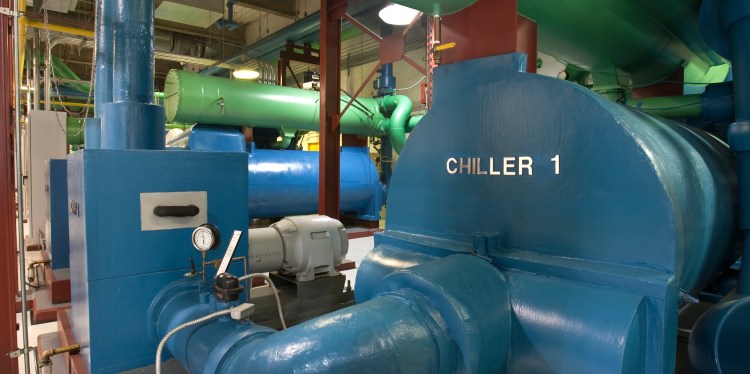
Chill-Pro® supports a comprehensive approach to predictive maintenance that protects the building owner’s investment in cooling equipment and keeps it operating reliably and efficiently.
Here are 8 Tips for maintaining Absorption Chillers…
- Maintain the Purge unit
Perhaps the most critical part of the system’s operation is the purge unit, which maintains the vacuum within the chiller shell by expelling air that leaks in. The pump should be operated at least once a week, even when the system is not in use.
- Leak-Test the unit regularly
Because an absorption chiller system requires vacuum conditions to generate cooling, air leaks sharply reduce system performance and reliability. If the system requires frequent purging, it should be pressure-tested as soon as possible to check for air leaks. Leaks should be repaired promptly.
- Test for tube leaks
If leaks are detected at the head of the generator, evaporator, condenser, or absorber, there may be a leak in one of the tubes. Pressure tube testing or eddy current testing can be used. Replace faulty tubes as necessary.
- Check for tube fouling and scaling
A drop in capacity may indicate that the tubes need to be cleaned. Cleaning frequency is influenced by local water characteristics, atmospheric contamination, operating conditions, and other local conditions. Two types of deposits can cause fouling: Dirt/rust/ sludge, and scale. Condenser tubes should be cleaned annually, at a minimum.
- Maintain the pumps
Seals on both solution and refrigerant pumps should be replaced when a leak is evident. The motor coolant system strainer should be cleaned while other maintenance functions are being performed.
- Make sure the lithium bromide is properly conditioned
For maximum protection, the system must have the proper lithium bromide salt concentration and inhibitor to prevent the salt solution from causing internal corrosion on the shell and tubes. Withdraw and test a sample of the salt solution and consult the manufacturer if alkalinity is too high.
- Inspect and verify the calibration of controls
Check all operating and safety controls, checking lights and gauges for accuracy. Inspect steam valve and make sure it is closing properly. Check power supply and unit fuses. Review the temperature readings on the cooling tower water. Check the settings of tower fans.
- Maintain a Data log
A good log may help an operator recognize early symptoms that could result in poor performance or damage to the unit.